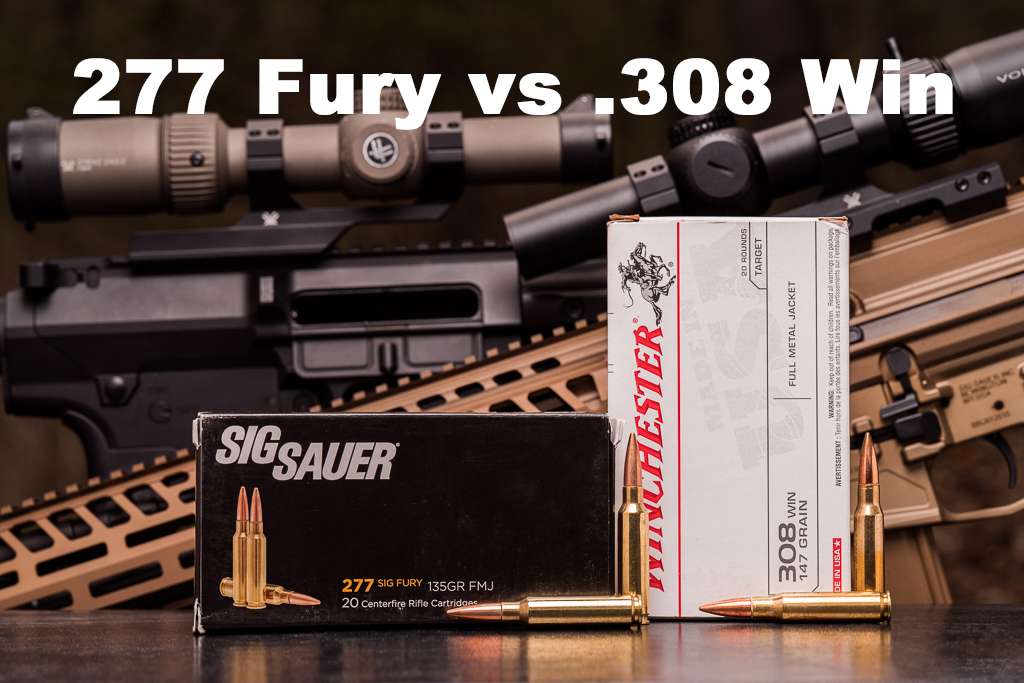


In this article, we present a detailed comparison of the modern .277 Sig Fury against the classic .308 Winchester. By analyzing size, shape, market conditions, and ballistic performance, we made informed recommendations for your ammo purchases.
When the United States military (specifically the Army) conducted a deep study into their small-arms capabilities, they reached a variety of conclusions. One of those conclusions was that their current weaponry was too light to go against modern opponents. If the U.S. had to face off against “near-peer” enemies (such as Russia or China), we would not have the firepower to punch through an opponent’s body armor from a significant distance.
So, as the military often does, they put out a request to ammo makers. The country needs a cartridge and weapons package that can defeat enemy armor from long range. And, as they often do, they received numerous submissions. After an exhaustive process, they chose a submission from Sig Sauer: a cartridge called the “.277 Sig Fury” and two military-grade rifles.
This launched the “.277 Fury,” as it’s come to be known, which has been gaining ground among civilian shooters since 2019.
When the U.S. military selected the Fury, it made many people wonder: Could this round replace the classic .308 Winchester? Could this upstart round elbow out the established high-powered cartridge? Should civilians, hunters, and hobby shooters adopt this new cartridge or should they stick with what they know?
To find out, we need to analyze these two cartridges from every angle, including pricing, availability, speed, and power. Only then can we make an informed decision.
.308 Win vs the .277 Fury: Fast Answers
Can’t wait for the analysis? Here’s a brief summary of the advantages for each option…
Advantages of the .308 Winchester:
- A wider bullet means larger wound channels
- More ammo options, including lighter and heavier bullets
- Greater affordability
Advantages of the .277 Sig Fury:
- Faster downrange speeds
- Stronger energy, especially downrange
- Less drop and wind drift
.308 Winchester vs the .277 Fury: Specs
| .308 Winchester | .277 Sig Fury | |
|---|---|---|
| Released | 1952 | 2019 |
| Bullet Diameter | 0.308 inches | 0.278 inches |
| Neck Diameter | 0.3433 inches | 0.31 inches |
| Base Diameter | 0.4728 inches | 0.4703 inches |
| Case Length | 2.015 inches | 2.015 inches |
| Overall Length | 2.8 inches | 2.825 inches |
| Bullet Weights | 110 - 180 grains | 135 - 155 grains |
| Max pressure | 62,000 psi | 80,000 psi |
| Primary Firearm | Semiautomatic AR-style rifles (Primarily AR-10) | Semiautomatic and bolt-action rifles |
Physical Differences and Similarities
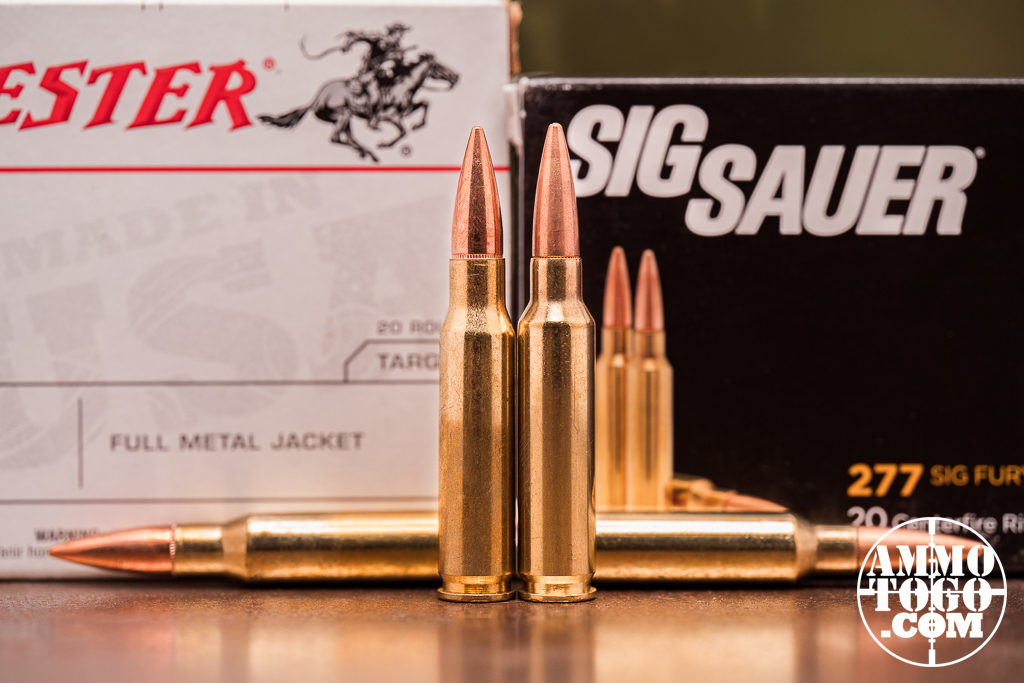
Physically, these two rounds have a lot in common. If you hold both in your palm, the size and shape differences are not immediately obvious. They have a similar overall length, case length, and case diameter, making them appear like virtual twins.
However, the bullet diameter is different. As the names suggest, the .308 Winchester has a wider bullet than the .277 Fury. This width allows the .308 to seat heavier bullets, although the .277 could, if other manufacturers join in, be offered in heavier rounds as well.
There is one obvious physical difference: the .277’s steel case head. This feature allows the cartridge to handle its most important factor: massive internal pressure.
Internal Pressure: The Biggest Difference
The .277 Sig Fury is built with a reinforced steel case head, allowing it to handle some of the highest internal pressures ever certified by SAAMI. Basically, with 80,000 psi of internal pressure, the Fury needs additional support to hold everything together. When we analyze the ballistics, we’ll see how this internal pressure impacts speed, energy, and trajectory.
Market Conditions
The .308 has a wider range of bullets, not only variety but weight options. At the time of writing this in 2026, your 277 Sig Fury ammo options are limited to three choices: a 135-grain FMJ, a 150-grain hunting round, and a 155-grain match round. (All from Sig Sauer.)
The options for .308 ammo are far more expansive. Nearly every manufacturer makes at least one .308 round; most have five or six options. (For example, when writing this article, Hornady listed twenty-six .308 Winchester products.)
Affordability goes to the .308 as well. The round is available in more options, including low-cost bulk ammo. Overall, the .277 has a long road before it can match the .308’s user friendliness.
.308 Winchester vs .277 Sig Fury: The Ballistics
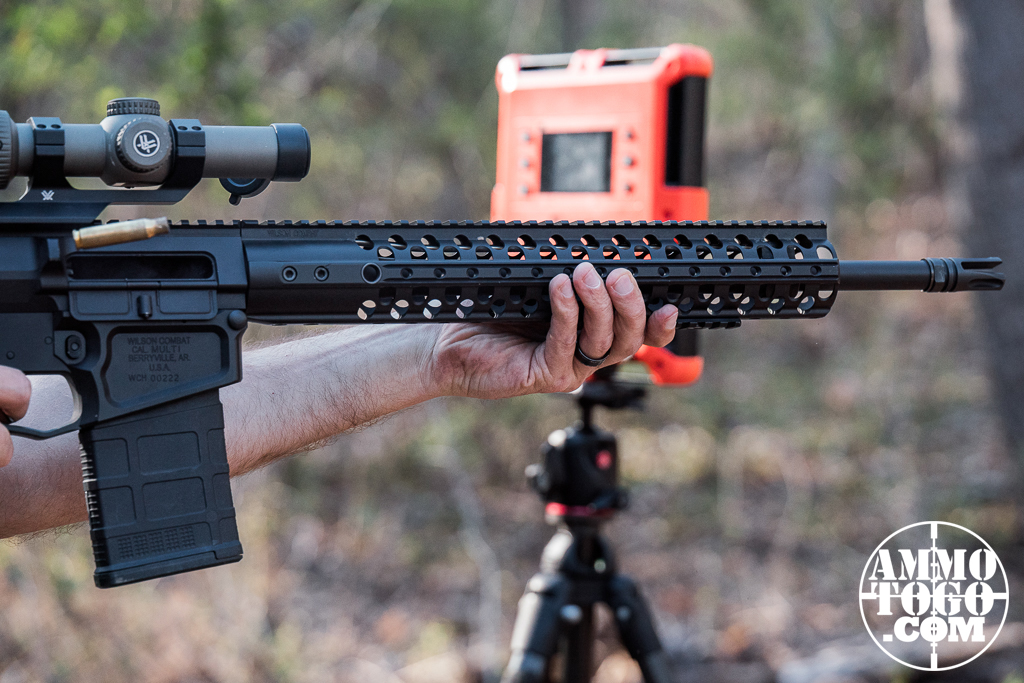
Unlike .308 ballistic data, current ballistic data for the .277 Sig Fury is limited. However, using listed muzzle velocity, grain weights, and ballistic coefficients, we can estimate bullet performance. With ballistic calculators, we gain an insight into the .277’s overall capabilities. It doesn’t replace real-world testing, but it allows us to create an educated ballistic comparison between the .308 Winchester and the .277 Fury.
Velocity
| .277 Sig Fury | Muzzle (fps) | 100 | 200 | 300 | 400 | 500 |
|---|---|---|---|---|---|---|
| 135-grain Full Metal Jacket Elite Ball | 3,000 | 2,797 | 2,604 | 2,418 | 2,240 | 2,070 |
| 150-grain Hybrid Hunter Nosler Accubond | 3,000 | 2,807 | 2,623 | 2,446 | 2,275 | 2,112 |
| 155-grain Hybrid Match Sierra MatchKing | 3,000 | 2,824 | 2,655 | 2,492 | 2,335 | 2,184 |
| Average | 3,000 | 2,824 | 2,655 | 2,452 | 2,283 | 2,122 |
| .308 Winchester | Muzzle (fps) | 100 | 200 | 300 | 400 | 500 |
| 130-grain Varmint & Predator JHP (Federal) | 3,050 | 2,691 | 2,359 | 2,052 | 1,769 | 1,516 |
| 168-grain MatchKing OTM (Remington) | 2,680 | 2,494 | 2,315 | 2,143 | 1,979 | 1,823 |
| 180-grain Power-Shok JSP (Federal) | 2,570 | 2,345 | 2,131 | 1,929 | 1,740 | 1,565 |
| Average | 2,767 | 2,510 | 2,268 | 2,041 | 1,829 | 1,635 |
Sig Sauer lists a muzzle velocity of 3,000 fps for all three Fury products. It seems unlikely that these numbers are accurate (real-world testing will likely show different speeds) but based on the available stats, the .277 Fury is a faster cartridge.
When the .308 is loaded with lighter rounds, it has a chance at matching the .277’s initial speed. Downrange, however, it appears the Fury has a clear speed advantage. This was, after all, the overall purpose of the design.
Many rounds will be outpaced by the .308 Winchester. Just not the .277 Sig Fury
Energy
| .277 Sig Fury | Muzzle (ft-lbs) | 100 | 200 | 300 | 400 | 500 |
|---|---|---|---|---|---|---|
| 135-grain Full Metal Jacket Elite Ball | 2,697 | 2,345 | 2,032 | 1,753 | 1,504 | 1,284 |
| 150-grain Hybrid Hunter Nosler Accubond | 2,997 | 2,624 | 2,291 | 1,992 | 1,724 | 1,485 |
| 155-grain Hybrid Match Sierra MatchKing | 3,097 | 2,744 | 2,426 | 2,138 | 1,877 | 1,641 |
| Average | 2,930 | 2,571 | 2,250 | 1,961 | 1,702 | 1,470 |
| .308 Winchester | Muzzle (ft-lbs) | 100 | 200 | 300 | 400 | 500 |
| 130-grain Varmint & Predator JHP (Federal) | 2,685 | 2,090 | 1,606 | 1,215 | 903 | 664 |
| 168-grain MatchKing OTM (Remington) | 2,679 | 2,320 | 1,999 | 1,714 | 1,461 | 1,239 |
| 180-grain Power-Shok JSP (Federal) | 2,640 | 2,197 | 1,816 | 1,486 | 1,209 | 979 |
| Average | 2,668 | 2,202 | 1,807 | 1,472 | 1,191 | 961 |
If our calculations are even remotely accurate, the .277 Sig Fury has a clear energy advantage. From the start, it’s giving off about 3,000 ft-lbs of force, while the .308 starts at roughly 2,600 to 2,700.
Muzzle energies are interesting, but what’s most notable is the downrange performance. The .277 Sig Fury is capable of reaching over 1,600 ft-lbs at 500 yards. The .308 is, at absolute best, shy of 1,300.
The .308 is one of the most powerful rounds on the civilian market, but even this immensely popular cartridge is overmatched by the high-pressured .277 Fury.
Trajectory
| 100 (Inches) | 200 | 300 | 400 | 500 | |
|---|---|---|---|---|---|
| 135-grain Full Metal Jacket Elite Ball | 2 | 0 | -7 | -19 | -39 |
| 150-grain Hybrid Hunter Nosler Accubond | 1 | 0 | -7 | -19 | -38 |
| 155-grain Hybrid Match Sierra MatchKing | 1 | 0 | -6 | -18 | -37 |
| Average | 1 | 0 | -6 | -19 | -38 |
| .308 Winchester | 100 (Inches) | 200 | 300 | 400 | 500 |
| 130-grain Varmint & Predator JHP (Federal) | 2 | 0 | -8 | -24 | -52 |
| 168-grain MatchKing OTM (Remington) | 2 | 0 | -9 | -25 | -50 |
| 180-grain Power-Shok JSP (Federal) | 2 | 0 | -10 | -30 | -61 |
| Average | 2 | 0 | -9 | -26 | -54 |
Again we see that the .277 Sig Fury shows outstanding performance as a long-range cartridge. High ballistic-coefficient bullets, cruising along at fast speeds, deliver excellent trajectories, especially for a round that uses heavier projectiles. This is another result of the immense internal pressures.
The .308 Winchester has strong numbers, but again we simply see stronger stats from the modern .277 Fury, which has less than 40 inches of drop at 500 yards.
Recoil
While the .277 has higher muzzle energies, it’s gaining a reputation for relatively light recoil. Considering the high downrange performance of this round, it doesn’t hammer the shoulder.
The recoil difference between these two rounds is slight, and most won’t perceive a difference. Advanced measurements may detect a difference, but most shooters will not. Therefore, we’re calling this a draw.
Modern or Vintage: .277 Sig Sauer or .308 Winchester?
Now that we understand these two cartridges, we can make informed assumptions about their overall performance and capabilities.
Although the .277 Sig Fury has superior speed and energy, the .308 Winchester remains a popular choice thanks to a lower cost and greater availability. Shooters can find a higher variety of cartridges, including bulk or discount ammo for target shooting. For most shooters, especially moderate fans and shooting enthusiasts, the .308 remains supreme.
But the .277 is an excellent option as well. For advanced or serious shooters who want higher performance and stronger energies, as well as better accuracy, the .277 Fury is an interesting option.