
A side-by-side look at the 45-70 vs 30-30 rifle calibers.
There’s just something special about lever action rifles.
They may not be as technologically advanced as modern semi-automatic rifles, but loading, cocking, and discharging a lever gun just…feels good. There’s really no better way to describe it. Hunting and shooting with a lever action rifle often seems more satisfying than any other pursuit.
If you are interested in a lever action, you have a lot of choices for ammo selection, but two of the most popular cartridges are the .45-70 Government and the .30-30 Winchester. Both are proven cartridges with over a century of use, and both can deliver the performance you need from a lever-action rifle. But if you only have the cash or the space in your safe for one of them, which should you choose in a .45-70 vs .30-30 contest?
.45-70 vs .30-30 Winchester: Fast Answers
Too busy for details? Here are the basic advantages of the .30-30 Winchester and .45-70 Government:
Benefits of the .30-30 Winchester:
- Lower ammo costs
- More ammo options
- Faster velocities
- Straighter trajectories
Benefits of the .45-70 Government:
- More energy to the target
- Larger, heavier bullets
- Better for long-range or large-game hunting
The .45-70 Gov’t vs the .30-30 Win
| .45-70 Government | .30-30 Winchester | |
|---|---|---|
| Released | 1873 | 1895 |
| Bullet Diameter | 0.458 inches | 0.308 inches |
| Neck Diameter | 0.48 inches | 0.33 inches |
| Base Diameter | 0.505 inches | 0.422 inches |
| Case Length | 2.105 inches | 2.04 inches |
| Overall Length | 2.55 inches | 2.55 inches |
| Case Capacity | 0.368 cubic inches | 0.169 cubic inches |
| Common Bullet Weights | 250 to over 400 grains | 125 - 170 grains |
| Typical Firearm | Lever-action rifles | Lever-action rifles |
The .45-70 cartridge usually fires a much heavier bullet than the .30-30. It’s slower in terms of muzzle and downrange velocity but typically delivers more energy into a target. Essentially, a .45-70 has more “stopping power” than a .30-30 and can typically be used on large game, while the .30-30 is suitable for deer-sized animals but not moose or bear.
About the .45-70 Government

Today, cartridges made for lever-action rifles are used for private sporting purposes only; they are found on hunting grounds and target ranges. But the .45-70 Government was made for the battlefield. Seeking a flat-shooting, powerful weapon, the U.S. Army’s Springfield Armory developed the cartridge, which quickly became popular among sportsmen. With the right load, it can be used for some of the largest game in North America, yet can also be an enjoyable target cartridge as well.


About the .30-30 Winchester

Created for the famous Winchester Model 1894 rifle, the “thirty-thirty” cartridge became popular for target shooting and medium-range, medium-size hunting. More powerful than most of the competition at the time, it proved a lightweight yet effective round that could be used for deer, black bear, and similarly-sized game. Thanks to an affordable price and versatile use, it became one of the most popular rounds in the country and remains an effective hunting option to this day.







45-70 vs. 30-30 Price Comparison

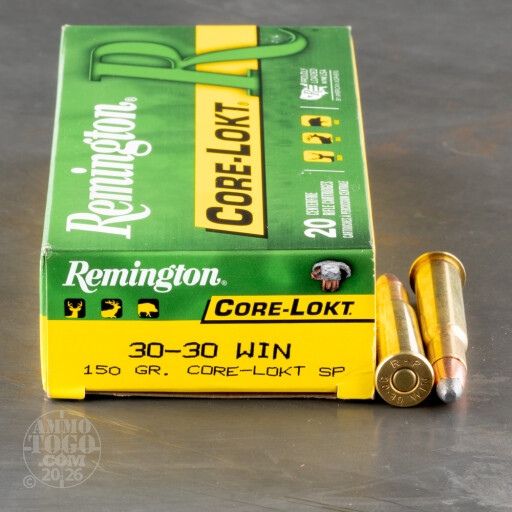
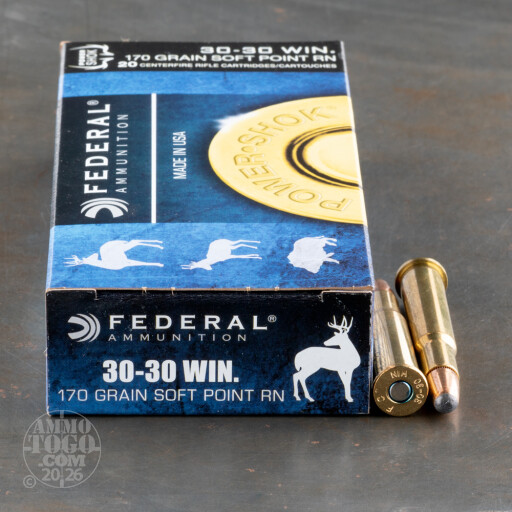
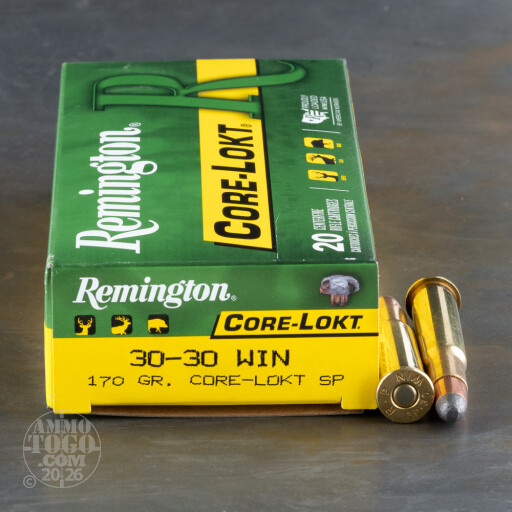
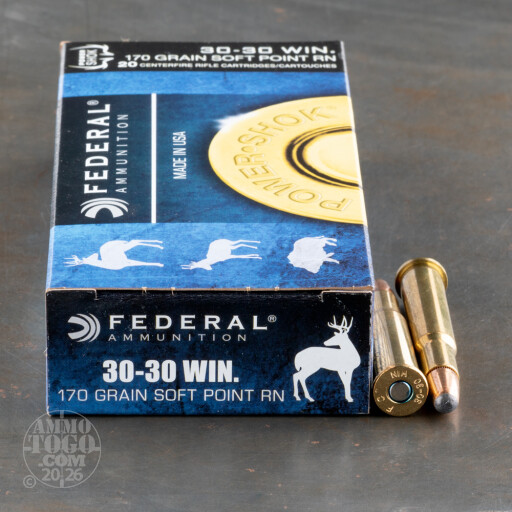
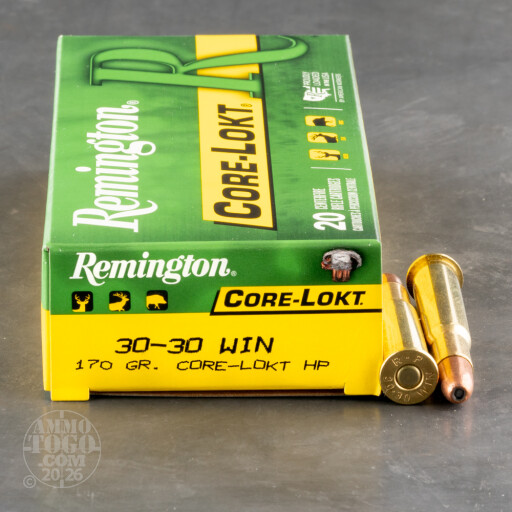
These are not high-volume rifle cartridges; it’s unlikely that you’ll fire off close to a thousand rounds in a single afternoon, the way you might with a semi-automatic rifle discharging .223 Remington cartridges, for example. But even lever-action owners appreciate an affordable round. In this case, it appears the .30-30 is significantly more affordable. At the time of writing this article, the most affordable .30-30 on our site was $.74 per round, while prices for .45-70 Government ammo bottomed out at well over double that amount.
Comparable products repeated this trend. Hornady’s LEVERevolution is available in both cartridges; the 160-grain .30-30 was $1.23 per round, versus 325-grain .45-70 priced at $1.75 per shot. So, no surprise there. You get a lot more material with a 45-70 than a 30-30. But in terms of cost per trigger pull, 30-30 has the edge.
Winner: .30-30 Winchester
45-70 vs 30-30 Velocity Comparison
| .45-70 Government | Muzzle Velocity (fps) | 100-yard Velocity (fps) | 200-yard Velocity (fps) |
|---|---|---|---|
| 250-grain MonoFlex LEVERevolution (Hornady) | 2,025 | 1,616 | 1,285 |
| 300-grain HP Flat Base Field Dynamic (Fiocchi) | 1,900 | 1,575 | 1,305 |
| 350-grain Flat Nose A-Frame (Swift) | 1,771 | 1,394 | 1,126 |
| 400-grain JHP Pioneer (Barnes) | 1,715 | 1,454 | 1,241 |
| Average | 1,853 | 1,510 | 1,239 |
| .30-30 Winchester | Muzzle Velocity (fps) | 100-yard Velocity (fps) | 200-yard Velocity (fps) |
| 170-grain Soft Point Silver Series (Browning) | 2,200 | 1,879 | 1,591 |
| 170-grain Jacketed SP Power-Shok (Federal) | 2,200 | 1,894 | 1,619 |
| 150-grain Soft Point Core-Lokt (Remington) | 2,390 | 1,974 | 1,607 |
| 170-grain Soft Point Power-Point (Winchester) | 2,200 | 1,879 | 1,591 |
| Average | 2,248 | 1,907 | 1,602 |
Usually, we like to look at ballistics stats to about 500 yards. But, because these rounds are limited in range, some manufacturers only provide velocity stats to 200 or 300 yards. Regardless, we still get a sense of these two rounds’ capabilities.
For velocity, we see a distinct advantage for the .30-30 Winchester. Although the case capacity of the .47-70 is higher, it’s throwing heavier bullets, which inherently slows the projectile. What we see, therefore, is fast speeds for the relatively light .30-30.
To be fair, neither of these rounds are considered speed racers. In the modern ammo industry, where 3,500 fps is not uncommon, a muzzle velocity of 2,300 (give or take) doesn’t stand out.
Regardless, for velocities, the .30-30 Winchester is just a bit faster.
Winner: .30-30 Winchester
Energy
| .45-70 Government | Muzzle Velocity (ft-lbs) | 100-yard Velocity | 200-yard Velocity |
|---|---|---|---|
| 250-grain MonoFlex LEVERevolution (Hornady) | 2,276 | 1,449 | 917 |
| 300-grain HP Flat Base Field Dynamic (Fiocchi) | 2,405 | 1,653 | 1,134 |
| 350-grain Flat Nose A-Frame (Swift) | 2,437 | 1,510 | 986 |
| 400-grain JHP Pioneer (Barnes) | 2,613 | 1,879 | 1,369 |
| Average | 2,433 | 1,623 | 1,102 |
| .30-30 Winchester | Muzzle Velocity | 100-yard Velocity | 200-yard Velocity |
| 170-grain Soft Point Silver Series (Browning) | 1,827 | 1,332 | 955 |
| 170-grain Jacketed SP Power-Shok (Federal) | 1,827 | 1,354 | 990 |
| 150-grain Soft Point Core-Lokt (Remington) | 1,902 | 1,297 | 860 |
| 170-grain Soft Point Power-Point (Winchester) | 1,827 | 1,332 | 955 |
| Average | 1,846 | 1,329 | 940 |
If you know a little about firearm physics, you can probably guess which one delivers more energy to the target.
The .45-70 delivers crashing power downrange. Throwing heavy rounds, it’s known as one of the hardest-hitting lever-action cartridges on the market. This reputation appears to hold, as we see significant power compared to the .30-30 Winchester.
With roughly 2,400 ft-lbs of muzzle energy, and an average power above 1,100 ft-lbs at 200 yards, the .45-70 shows impressive strength for a 19th-century round. The .30-30 performs well and, if we go by energy alone, can easily be used for deer hunting to at least 100 yards.
But overall, the .45-70 Government shows greater power and performance.
Winner: .45-70 Government
Trajectory
| 50 | 100 | 200 | |
|---|---|---|---|
| 300-grain HP Flat Base Field Dynamic (Fiocchi) | 0.7 | 0 | -12.7 |
| 350-grain Flat Nose A-Frame (Swift) | 1 | 0 | -16.6 |
| 400-grain JHP Pioneer (Barnes) | N/A | 0.0 | -15.7 |
| .30-30 Winchester | |||
| 170-grain Silver Series SP (Browning) | N/A | 0 | -8.4 |
| 170-grain Power-Shok JSP (Federal) | 0.3 | 0 | -8.4 |
| 150-grain Core-Lokt SP (Remington) | 0.2 | 0 | -7.6 |
| 170-grain Power-Point (Winchester) | N/A | 0 | -9 |
These rounds may not be considered long-range sniper loads, but it still helps to have a straight trajectory.
Based on this small sample, it’s fair to say that the .30-30 Winchester has a straighter trajectory. Of course, flight paths and accuracy are not the same, but if you plan on shooting targets at 200 or even 300 yards, the .30-30 Winchester is likely the better option.
Winner: .30-30 Winchester
Recoil
When using these cartridges for hunting, you will usually only place one shot; perhaps a secondary shot in rare situations. Even at the range, shooting is usually slow and meticulous, focusing on accuracy over volume. This means recoil is generally not as important. But it still matters to most shooters. Because the .30-30 Winchester usually has lighter muzzle energy, the felt recoil from these cartridges tends to be less severe.
Winner: .30-30 Winchester
| Winning Caliber | |
|---|---|
| Price | .30-30 Winchester |
| Velocity | .30-30 Winchester |
| Energy | 45-70 Government |
| Recoil | .30-30 Winchester |
Conclusion: Both are Fun, Powerful Cartridges

If you are trying to decide between 45-70 vs 30-30, you can’t go wrong. I may be slightly delusional, but there’s something about loading up an old-fashioned lever action and pretending to be John Wayne for an afternoon at the range. But these calibers are more than just accessories or stage props!
After reviewing all the factors, here are the benefits of each:
Choose the .45-70 if…
The .45-70 Government is your best option if you want more power and a wider bullet. Essentially, it’s a stronger hunting cartridge, although the .30-30 has been used for countless whitetails and other game animals. But if you want more downrange power and the chance to take larger game, consider the .45-70.
Choose the .30-30 if…
When you need a more affordable cartridge with a slightly softer kick, the .30-30 Winchester is the right choice. You’ll get reliable performance and accuracy at the range, and you’ll have ample power for deer hunting to roughly 100 yards. Frankly, most hunters will be perfectly suited by the trustworthy .30-30.
Load Your Lever Action with Affordable Ammo!
When you need affordable ammo for deer, varmint, elk, and all of your hunting pursuits, visit ammotogo.com. We’ll make sure you have the right rounds at a fair price, so browse our selection now!