


Bucky Lawson shares his experience using the Henry Homesteader 9mm carbine as a home-defense tool over the course of three years with range testing and more.
I’ve had my Henry Homesteader Carbine for just over three years now. I initially handled and fired it at its introduction at SHOT Show 2023 and decided I needed one for my own. Good decision. The Homesteader hasn’t disappointed me. I use it mostly for maintaining my basic rifle skills, otherwise known as plinking, and it also serves as a home defense rifle. I’ll address why I assigned it that role later. It’s a lot of fun and I think the Homesteader is among my most useful long guns.
If you’re unfamiliar with the Homesteader, it represents Henry’s first original foray into the world of semi-automatic firearms. It’s a clear departure from the lever action rifles that built the company’s reputation. Despite my very good first impression, I wondered how the Homesteader would hold up under extended use, considering Henry’s lack of history with such firearms. Time and many, many rounds have long put those concerns to bed. I can’t even tell you how many rounds my Homesteader has fired. A couple thousand anyway.
The gun’s 9mm Luger chambering has a lot to do with that. It’s a rifle I can actually afford to shoot a lot. Love my other long guns, but the only rifles I shoot as much as, or more than, my Homesteader are my .22s and AR-15s, and the latter are more expensive to shoot than the Henry. The 9mm Homesteader also fits into a kind of sweet spot between .22 and AR. It’s nice and it’s fun.
So, let’s get into the Henry Homesteader Carbine, what it is, why I like it so much, and a couple of small upgrades I made.
Henry Homesteader Carbine Features
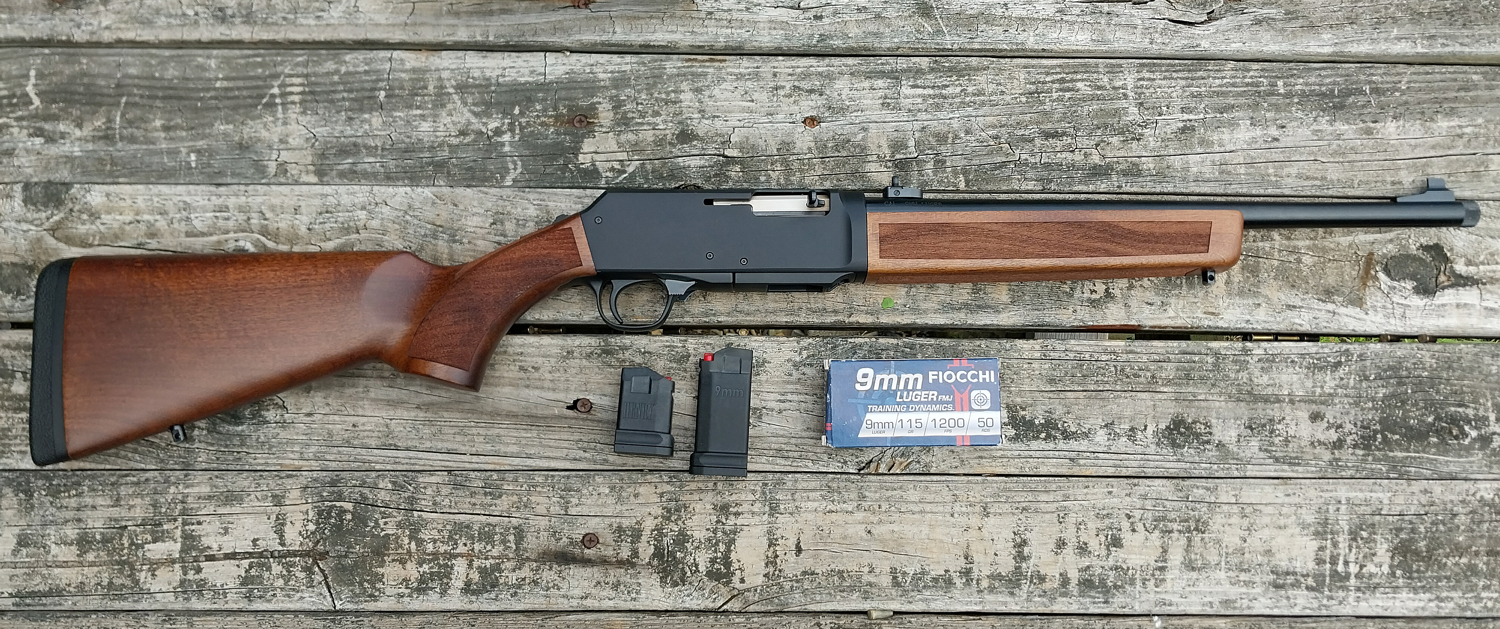
Operationally, the Homesteader reminds me of the M-1 Carbine and the Ruger 10/22, while it kind of looks like a Browning BAR (the hunting rifle, not the World War II squad weapon). The side charging handle is familiar, except the Homesteader’s is reversible, unlike those on the other rifles. The reversal process is simple, requiring only a minute or two. That ambidexterity extends to the tang-mounted thumb safety, the 10/22-like mag release, and the bolt catch located just forward of the trigger guard.
Stock & Forend
The American walnut stock is solid and it looks nice, but the gun is still pretty light at 6.6 pounds. The walnut forend conceals a recoil mitigating device that Henry calls a “reciprocating mass.” Basically, it’s a weight that times the blowback action, facilitating proper ejection of the spent casing. The extra weight also helps with muzzle rise, though the recoil is almost negligible,
Barrel
The 16-inch barrel features a threaded muzzle for a suppressor or other device. I’ve run it with a suppressor and a brake. The suppressor stays on when it’s staged for home defense. I shoot it both ways on the range, or with no device at all.
Sights
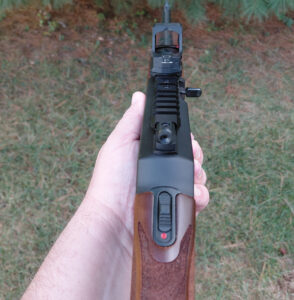
The factory sights consist of a blacked-out front blade and a ghost ring set just forward of the receiver. They work fine, but there was more air than I like in the ghost ring. So, I replaced it with a Picatinny rail section and a Skinner Sights peep sight. That’s attached to the top of the receiver, is which drilled and tapped for the Weaver 63B footprint. The peep sight gave me a better aperture and moved the rear sight to the receiver’s rear, extending the sight radius as God intended. The rail also allows an optic. I currently run a red dot.
Compatible Magazines
The Homesteader ships with one 5-round and one 10-round proprietary Henry magazine. I was a little skeptical at first since new mags can be weak spots, and Henry lacked some experience. But, again, my concerns were quickly dispelled. The Henry mags work very well indeed, and I’ve never had so much as a hiccup from them.
But Henry also provides other options. For an extra 30 bucks or so, you can purchase an adapter kit that allows your Homesteader to use Glock 19 and 17, Sig Sauer P320, or Smith & Wesson M&P 9mm mags. That obviously opens up some possibilities for expanded capacity and easy acquisition of extra magazines. It also provides opportunities for you to use the same mags in your carry gun and your truck gun. That’s a very attractive proposition and shows that Henry thinks about what their customers might want.
I got the Glock attachment even though I don’t own a Glock (don’t start). It made sense to me since Glock mags are everywhere and they aren’t all that expensive. I haven’t installed it because the Henry mags work so well. But I recently got a Stribog SPA3G that uses Glock mags, so it’s probably time.
Running the Henry Homesteader

From the beginning, I’ve viewed the Homesteader as a workmanlike firearm, despite its admittedly attractive profile. The 9mm cartridge makes it ideal for varmints or self-defense. A handy, carbine-length gun in an easy-to-shoot caliber is a nice gun to have in the truck too.
But a gun that has an actual job, or jobs, has to run reliably. Every time. And brother, my Homesteader does just that. As I noted, I have at least a couple thousand rounds through this gun. I have not experienced a single malfunction that I can remember, and I’m pretty sure I would remember, given my job. I mainly run 115 and 124-grain FMJ on the range, though I occasionally shoot some +P defensive rounds since that’s what I load in the home defense magazines.
Range Testing
I recently ran the Homesteader through a deliberately-hard range session using ammo from my friends at Ammo-to-Go. Using all my Henry mags, with my co-tester reloading them as I used them up, I put 270 rounds through the gun as fast as I could shoot them. The Homesteader got hot and it got filthy. The mags were covered in residue and took a while to clean out. But the gun ran like a champ. Steel rang through that little valley like bells when the British were coming. I was really proud of my Homesteader. Not so happy when I had to clean everything, but this was for science and all. It’s not, however, something I’ll likely repeat.
I used the following loads in the test:
- 115-grain Blazer Brass FMJ (50 rounds)
- 115-grain Federal American Eagle FMJ (50 rounds)
- 124-grain PMC Bronze FMJ (100 rounds)
- 124-grain Sellier & Bellot FMJ (50 rounds)
- 124-grain Remington Golden Saber +P BJHP defensive rounds (20 rounds)
My Homesteader as a Home Defense Carbine
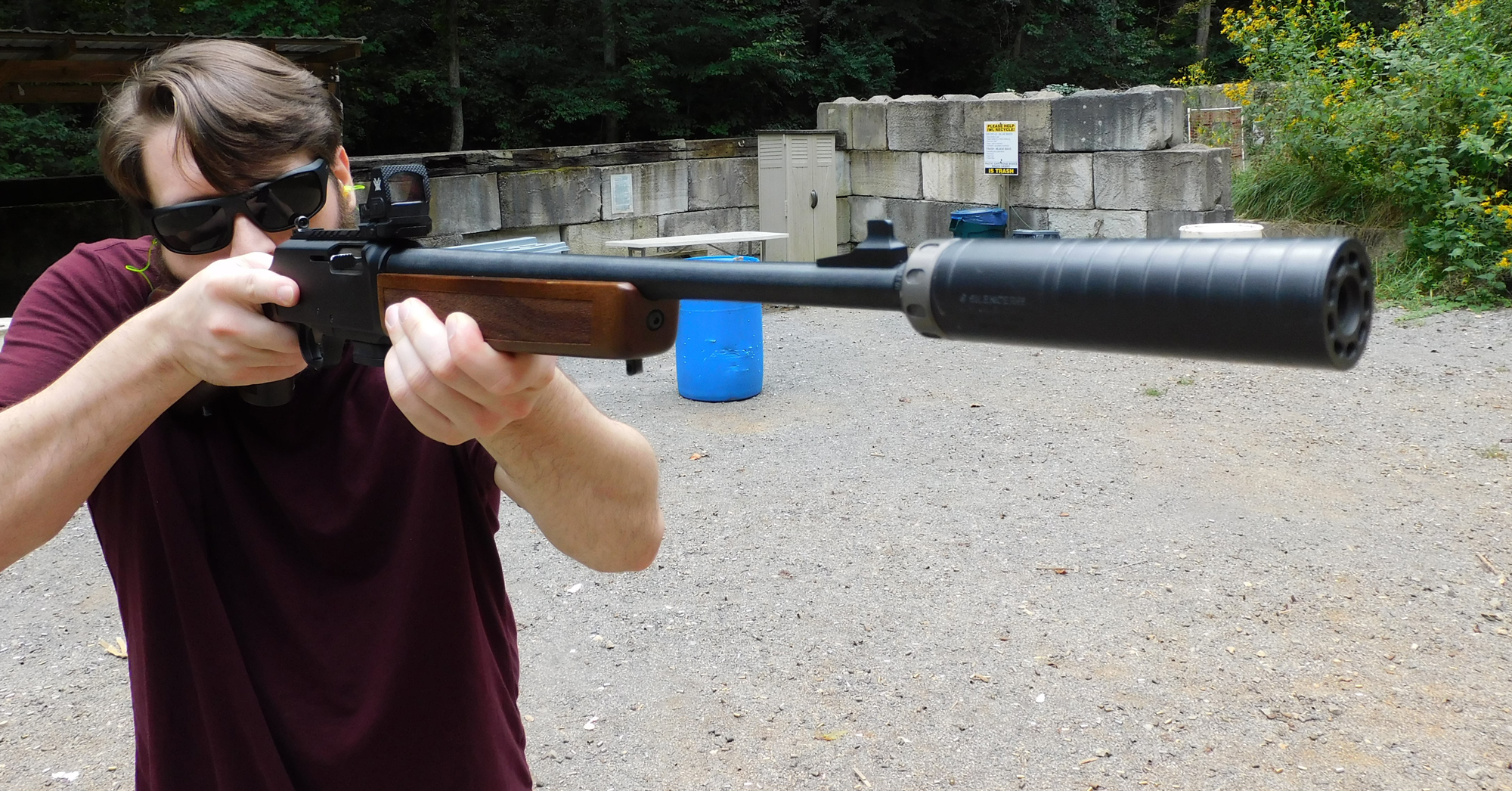
I mentioned that I use my Homesteader in the home defense role. Here’s why. First, the gun has proven itself reliable and capable. Second, the 9mm cartridge is less likely to penetrate walls than a 5.56 NATO round. Third, I can suppress it so I’m less likely to blow out my eardrums. Fourth, the 16-inch barrel makes it handy enough for indoor work. Fifth, I love it with an unmagnified red dot.
And finally, the traditional wood and steel look means an overzealous prosecutor is somewhat less likely to try to make an example of me if things go sideways. That’s not a joke, as you know if you read the right firearm publications.
The only thing it lacks in the home defense role is the ability to easily attach a weapon light. Henry offers a newer Homesteader with an M-Lok-compatible forend, but they don’t seem to sell the forend separately. I’m looking for options to attach a light.
The Homesteader isn’t my only home defense gun, but it’s an important part of my system.
Henry Homesteader vs Ruger PC Carbine
If you’re shopping carbine options, odds are good you’re considering the Henry or Ruger’s popular PC Carbine. Both are excellent options and could have a place in your safe at home.
On looks alone, the Henry is the classic choice while Ruger’s PC Carbine is the more tactical “black rifle” looking option.
Ruger’s PC Carbine features faster takedown, with a quick release barrel assembly. (You’ll need to release pins to takedown the Homesteader.) Many shooters also find the Ruger’s accessories and customization options appealing. Henry doesn’t have the same breadth of available trigger-swaps, etc.
In terms of performance, the rifles are similar. The Henry name may command a slightly higher price and its stock walnut stock adds some class to the package. That said, there are options for Walnut Ruger PC Carbine furniture out there too.
Parting Shots
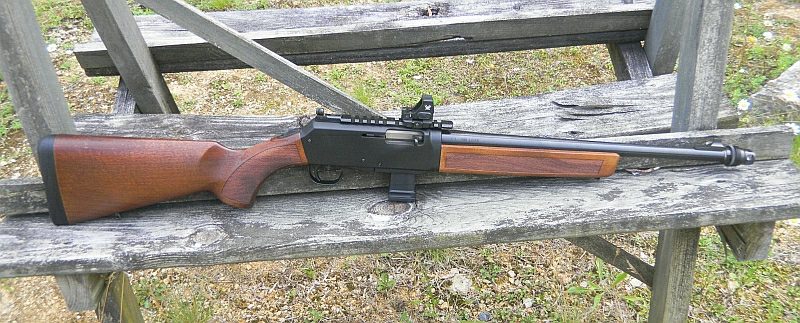
I make no bones about liking my Homesteader. But the gun has earned that regard. It’s reliable, accurate, and a lot of fun. The recoil is negligible, and it works great with a suppressor. I’ve found that I particularly like it with an unmagnified red dot optic, and I’m currently running a Vortex Defender-ST on it. I zeroed the optic at 85 yards, and I regularly shoot it out to 125.
But it’s only fair that I express my one complaint, other than the factory ghost ring sight. I don’t care for the mag release. Don’t get me wrong, it works exactly like it’s supposed to. But it doesn’t feel natural to me and I have the same complaint about my Ruger 10/22s since they have the same kind of catch. Both complaints are subjective, personal opinions, but I’ve gone on so much about how great the gun is that I felt I should mention what I don’t like. So, there it is.
The Homesteader is a handy, fun little carbine. If you’re looking for something like that, check out the Homesteader. It made a splash back in 2023, and with good reason. Three years in, I haven’t regretted mine for even one second.
Henry Homesteader Specifications
- Caliber: 9mm Luger (+P and +P+ rated)
- Capacity: Various, depending on magazine setup. Ships with one 5 and one 10-round Henry magazine.
- Semi-automatic
- Barrel length: 16.37 inches
- Overall Length: 35.75 inches
- Length of Pull: 14 inches
- Weight: 6.6 lbs.
- Threaded Muzzle (Unthreaded variant available to comply with state laws)
- American Walnut Stock and Forend
- Tang-Mounted Thumb Safety
- Ambidextrous Controls with a Reversible Charging Handle
- Available Glock, Sig Sauer, and Smith & Wesson M&P Magazine Adapter Kits