


A side by side comparison of two popular pistol calibers – the 9mm vs 45 ACP.
It’s perhaps the most debated rivalry in the ammunition industry.
The 9mm Luger and the .45 ACP represent a massive portion of ammo sales and use. When selecting a self-defense or target-shooting pistol, these two rounds are guaranteed to be on the list.
But is one “better” than the other? Is one a superior choice for personal defense or target shooting?
We may never settle this debate, but by taking an honest look at the two rounds, by examining their market conditions and ballistic stats, you can make an informed decision when choosing a defense or target gun.
As a bonus, you’ll be better equipped when the enviable “9mm Luger vs .45 ACP” discussion begins.
9mm vs 45 ACP – Specs
| 9mm Luger | 45 ACP | |
|---|---|---|
| Released | 1901 | 1905 |
| Bullet diameter | 0.355 inches | .452 inches |
| Neck diameter | 0.38 inches | .473 inches |
| Base diameter | 0.391 inches | .476 inches |
| Rim diameter | 0.392 inches | .48 inches |
| Case length | 0.754 inches | 0.898 inches |
| Case capacity | 0.826 cubic centimeters | Max 1.78 cubic centimeters |
| Total length | 1.169 inches | 1.275 inches |
| Bullet weights | 70- 150 grains | 135 - 230 grains |
| Common firearm | Semiautomatic pistols | Semiautomatic pistol (1911) |
| Common magazine capacity | Up to 20 | Up to 14 |
Size and Shape
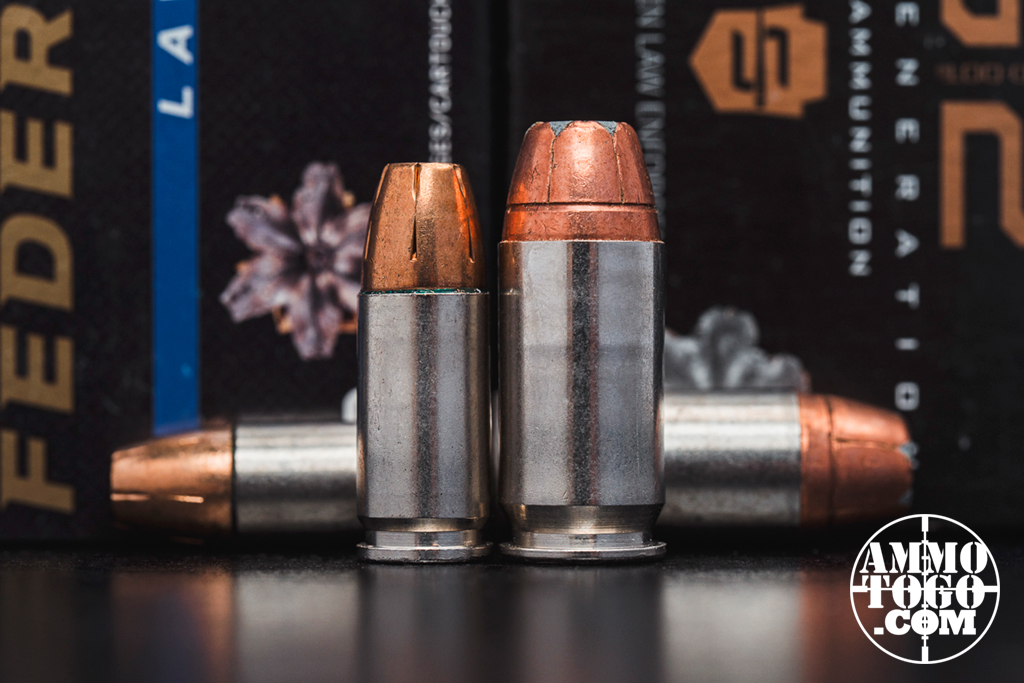
It’s common knowledge that the .45 ACP, also known as the .45 Auto, is a larger cartridge. It has a wider bullet and a larger case, with a much greater case capacity. It also packs heavier bullets. While the typical 9mm Luger is around 115 to 147 grains, common .45 ACP rounds start at 185 grains and top out around 230. There are outliers, such as a 70-grain 9mm product or a 135-grain .45 ACP cartridge, but most fall within these ranges.
The 9mm Luger, which also goes by “9x19mm Parabellum” and “9mm NATO,” is thinner, but it’s not drastically shorter. The length difference, as we see from the above chart, is about one-tenth of an inch. That said, when stacked side-by-side, the 9mm is clearly a smaller load.
Market (Availability and Pricing)
Both of these rounds are readily available on the ammunition market, although there is a slight advantage for the 9mm Luger. This round is the most commonly-used centerfire handgun load in the country with mass adoption by users of all types and purposes. Pricing generally favors the 9mm Luger. In normal markets, it’s not uncommon for budget 45 ACP loads to cost shooters 30% more than 9mm ammo.
As far as availability, neither has a real advantage. In times of low supply, the 9mm may get scooped up faster because of more users, but both rounds are typically available to shooters.
Firearm Type and Firearm Capacity
Although both of these rounds are fired from semi-automatic pistols, the 9mm weapons tend to be smaller while holding more rounds. The M1911 is an extremely popular handgun, but most would agree that, for the majority of users, the a typical 9mm handgun is better for comfortable conceal carry. (And let’s be clear, comfort is essential.)
Typical 9mm handguns hold 13 to 15 rounds, although there are plenty of options with 17- or even 20-round magazines. .45 ACP handguns hold fewer; the standard 1911 magazine holds seven rounds total.
9mm vs 45 Auto: Performance/Ballistics
To compare these rounds, we looked at ballistic stats from ten products; five in each cartridge. We selected rounds from Federal, Remington, and Speer, as these manufacturers provide consistent data on velocity, energy, and trajectory.
We should note that for this comparison, we left our +P ammo, which is available for both cartridges. However, not all firearms can handle +P (although many modern firearms can) so we stuck with the “normal” rounds.
Velocity
| 9mm | Muzzle (fps) | 25 Yards | 50 Yards | 75 Yards | 100 Yards |
|---|---|---|---|---|---|
| Federal American Eagle 115 Gr FMJ | 1,180 | 1,106 | 1,048 | 1,001 | 961 |
| Remington Golden Saber 124 Gr JHP | 1,125 | 1,074 | 1,031 | 995 | 963 |
| Speer Lawman 124 Gr TMJ | 1,090 | 1,047 | 1,011 | 979 | 951 |
| Federal Hydra-Shok 135 Gr JHP | 1,060 | 1026 | 996 | 970 | 946 |
| Speer Gold Dot 147 Gr JHP | 1,088 | 1,042 | 1,004 | 971 | 942 |
| 45 ACP Ammo | |||||
| Remington HTP 185 Gr JHP | 1,000 | 968 | 939 | 913 | 889 |
| Speer Gold Dot 185 Gr JHP | 1,050 | 998 | 955 | 919 | 886 |
| Federal Hydra Shok 210 Gr JHP | 980 | 952 | 927 | 903 | 882 |
| Federal Hydra Shok 230 Gr. JHP | 900 | 882 | 865 | 848 | 832 |
| Remington Golden Saber 230 Gr Bonded JHP | 875 | 853 | 833 | 814 | 795 |
The velocity stats are fairly similar, with lots of overlap. We see an average muzzle velocity of 1,088 feet-per-second for the 9mm Luger, with 961 for the .45 ACP. The 115-grain 9mm Luger has the best speeds, clocking in at 1,180 for muzzle velocity. The slowest was the 230-grain .45 ACP from Remington, which dropped below 900 fps.
Energy
| 9mm | Muzzle (ft-lbs) | 25 Yards | 50 Yards | 75 Yards | 100 Yards |
|---|---|---|---|---|---|
| Federal American Eagle 115 Gr FMJ | 356 | 312 | 280 | 256 | 236 |
| Remington Golden Saber 124 Gr JHP | 348 | 317 | 293 | 273 | 255 |
| Speer Lawman 124 Gr TMJ | 327 | 302 | 281 | 264 | 249 |
| Federal Hydra-Shok 135 Gr JHP | 337 | 316 | 298 | 282 | 268 |
| Speer Gold Dot 147 Gr JHP | 317 | 299 | 284 | 270 | 257 |
| 45 ACP Ammo | |||||
| Remington HTP 185 Gr JHP | 411 | 385 | 362 | 343 | 325 |
| Speer Gold Dot 185 Gr JHP | 453 | 409 | 375 | 347 | 322 |
| Federal Hydra Shok 210 Gr JHP | 448 | 423 | 400 | 381 | 363 |
| Federal Hydra Shok 230 Gr. JHP | 414 | 397 | 382 | 367 | 354 |
| Remington Golden Saber 230 Gr Bonded JHP | 391 | 372 | 354 | 338 | 323 |
Unsurprisingly, the bigger, heavier .45 ACP logs superior energy stats. The role of energy in a self-defense situation is debated, (it matters, people just debate how much) but it’s clear that the .45 delivers more energy into the target.
Four of the five ACP rounds were above 400 ft-lbs of muzzle energy (with another at 391), while none of the 9mm Luger rounds surpassed this benchmark. This holds with the general perception that the .45 ACP is a stronger, more powerful round.
Trajectory
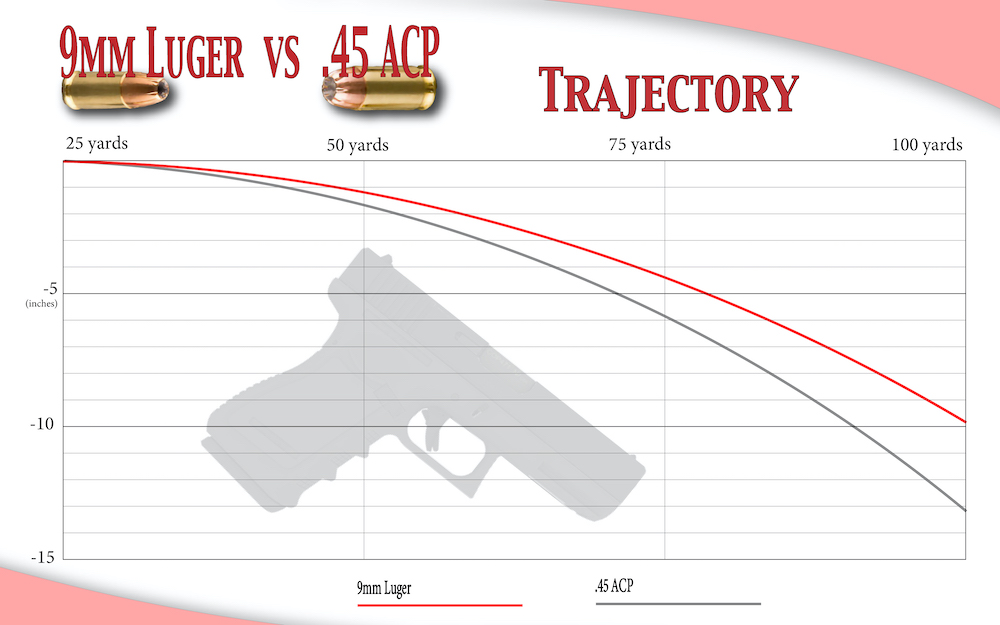
Trajectory is less of a concern for handguns than for rifles, but it’s still a factor. Within 50 yards, we can see that the 9mm Luger has slightly better trajectories, but the .45 maintains good stats as well. In the average handgun-related self-defense situation, a half-inch difference at 50 yards is practically insignificant, so it’s safe to say that trajectory is not a defining factor in these rounds.
Penetration & Self-Defense
Manufacturers do not provide penetration data, but we have an extensive collection of ballistic gel testing data we’ve independently gathered.
The average penetration for two dozen 9mm rounds was 14.3 inches, while the average for the .45 ACP was 13.5 inches. Both calibers offer numerous loads with penetration over 12 inches, the minimum depth recommended by the FBI.
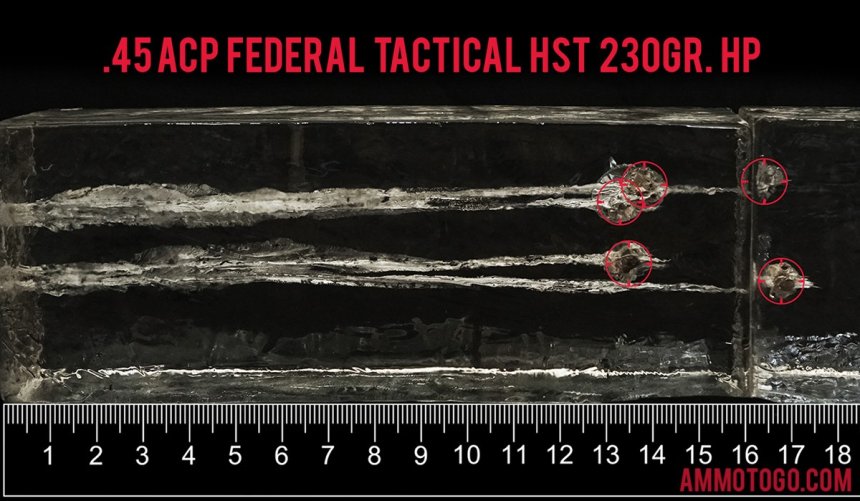
For example, in our Federal HST testing, we found 45 ACP 230 Grain HST ammunition penetrated to a median value of 13.7″ into synthetic gelatin.
Federal’s 147-grain HST ammo gave us nearly 4″ more of penetration with a median value of 17.5″ in our testing.
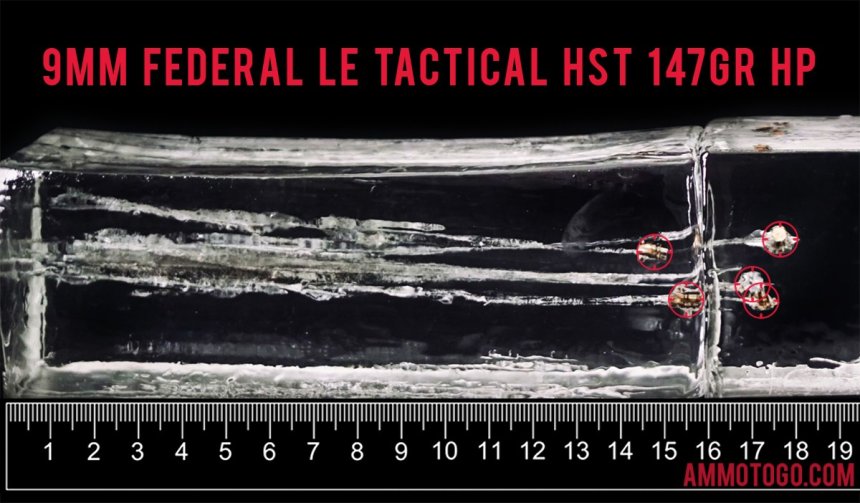
This stat suggests that the 9mm, while creating thinner wound channels, could be better for personal defense because it often penetrates deeper. However, along with penetration, most shooters will consider expansion of the rounds into their target. In that case, the 9mm expanded to a median diameter of .66″ compared to .85″ for the 45 ACP. Both matter but it’s up to you to determine what mix is ideal for your situation.
9mm Luger vs 45 ACP: Making the Choice
This is a tough choice, but, after reviewing the two rounds, a see a few clear advantages for each round. Glock’s Model 30 is a popular 45 ACP subcompact pistol, it handles 10-rounds in the magazine and another in the chamber (10 +1) while the
Advantages of the 9mm Luger…
- A smaller weapon for comfortable concealed carry.
- Best when users prefer higher capacity over more power.
- A more affordable option, which makes training cheaper.
- Lower recoil is often preferred by many shooters.
Advantages the .45 ACP…
- A thicker bullet for larger wound channels.
- Higher energies suggest greater “stopping power.”
- Often subsonic, so suppressed shooting is easier to achieve.
- Heavier guns can reduce felt recoil.
- An M1911-style handgun, chambered with .45 ACP, is a classic shooting experience.
Awesome Service, Affordable Prices, and Fast Shipping
The ammo you need is waiting! Visit our site to find affordable 9mm Luger ammo or .45 ACP rounds. From rifles to shotguns to handguns, you’ll find the right ammo for any firearm in your gun safe!